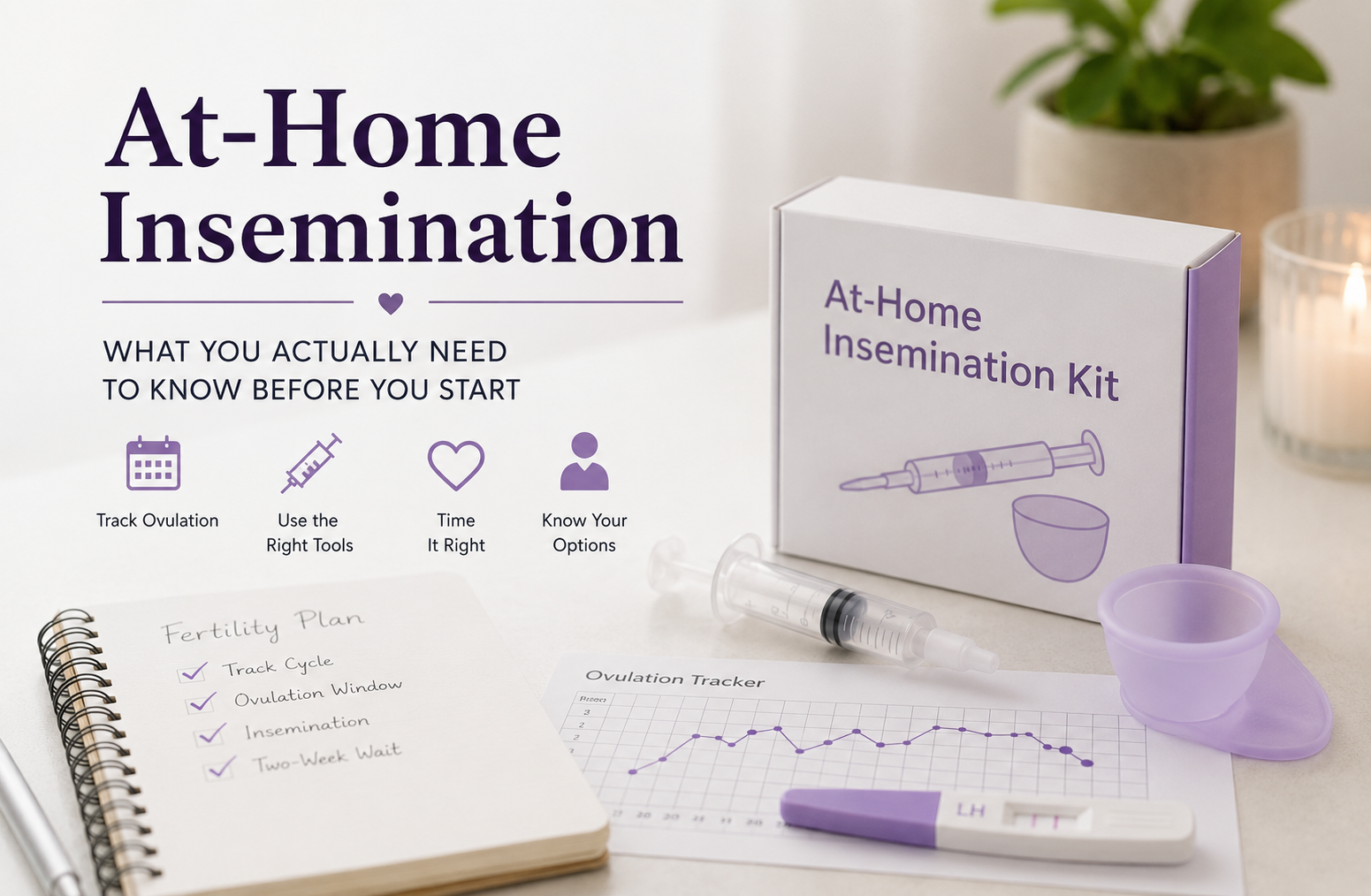
At-Home Insemination: What You Actually Need to Know Before You Start
So you’ve been doing your research. Maybe you’ve spent hours down fertility forum rabbit holes, bookmarked a dozen articles, and still feel like you’re piecing together a puzzle with half the pieces missing. You’re not alone. A lot of people arrive at at-home insemination — whether through choice, circumstance, or both — without a clear roadmap. This is that roadmap.
At MakeAmom, we work with women and couples who are taking their fertility journey into their own hands. At-home insemination, when done with the right timing and the right tools, has helped thousands of people conceive without a clinical setting. Here’s what the process actually looks like.
What Is At-Home Insemination?
At-home insemination is exactly what it sounds like — using a kit to introduce sperm into the reproductive tract outside of a medical office. The most common method used at home is intracervical insemination, or ICI. This involves placing sperm near or at the cervical opening using a small syringe. It’s a gentler approach than intrauterine insemination (IUI), which requires a catheter passing through the cervix and is typically done by a healthcare provider.
ICI is less invasive, doesn’t require a prescription in most states, and can be done in the privacy of your own home. That said, it does require some preparation — specifically, getting your timing right.
Ovulation: The Part That Makes or Breaks Everything
Here’s the truth nobody tells you loudly enough: insemination is only as effective as your timing. Sperm can survive in the reproductive tract for up to five days, but an egg is only viable for 12 to 24 hours after ovulation. Miss that window, and even perfect technique won’t matter.
This is why ovulation tracking isn’t optional. It’s the foundation of the whole process.
The three most reliable methods:
Ovulation predictor kits (OPKs) detect the LH surge that happens 24 to 36 hours before ovulation. They’re inexpensive, widely available, and give you a clear heads-up. Start testing about four days before you expect to ovulate, based on the length of your typical cycle.
Basal body temperature (BBT) tracking involves taking your temperature every morning before you get out of bed. Your temperature rises slightly — usually 0.2 to 0.5°F — after ovulation. It’s more useful for confirming that ovulation happened than predicting it, so pair it with OPKs if you can.
Cervical mucus monitoring is free and surprisingly reliable. In the days leading up to ovulation, discharge becomes clearer, slipperier, and stretchy — often described as resembling raw egg whites. That’s your fertile window.
Most people who are actively trying to conceive find that combining two or three of these methods gives them a much clearer picture than relying on any single one.
How an At-Home Insemination Kit Works
A standard at-home insemination kit includes a sterile syringe (needleless), a soft cup or cervical cap in some versions, and detailed instructions. Some kits also include an OPK or a conception lubricant that doesn’t harm sperm — regular lubricants often do, so this matters.
The process for ICI at home generally goes like this:
- Confirm your LH surge using an OPK.
- Plan to inseminate within 12 to 36 hours of the surge, ideally twice — once when the surge appears, and again the following day.
- If using donor sperm, ensure it’s been properly stored and prepared (washed vs. unwashed sperm matters for ICI specifically — unwashed is appropriate for ICI at home, while washed is needed for IUI).
- Use the syringe to gently deposit the sample near the cervix. Some people find lying down for 15 to 30 minutes after helps, though the evidence is mixed. It certainly doesn’t hurt.
- Track your cycle and note the date of insemination. This matters for both your records and any follow-up care.
The process feels clinical on paper. In practice, a lot of people say it feels surprisingly manageable once they’ve gone through it once.
Success Rates: Being Realistic
This is where we want to be straight with you. ICI at home isn’t a guaranteed shortcut. Success rates per cycle are generally in the range of 10 to 20%, which is actually comparable to what fertile couples experience through natural conception in any given month.
Age plays a significant role. For people under 35, success rates tend to be higher. Over 35, the picture becomes more variable, and it’s worth having a conversation with a fertility specialist sooner rather than later if things aren’t progressing after a few cycles.
Other factors — underlying conditions like PCOS or endometriosis, sperm quality, thyroid function — all affect outcomes. At-home insemination works best when there are no major underlying fertility issues. If you’ve been trying for several cycles without success, that’s useful information, not a reason to panic, but it is worth exploring further.
A Few Things People Wish They Knew Earlier
Stress is a real factor. The two-week wait between insemination and a potential positive test can be genuinely hard. Having something to do — a project, a plan, a support person to talk to — helps more than most people expect.
Sperm source matters. Whether you’re using a known donor or a sperm bank, make sure the sperm is appropriate for ICI (unwashed). Using washed sperm for at-home ICI can cause significant cramping and complications.
Give it time. Most fertility specialists recommend trying for at least three to six cycles before evaluating whether additional support is needed. One unsuccessful cycle isn’t a pattern.
Your mental health is part of your fertility health. This process can bring up a lot — grief, hope, frustration, joy, sometimes all in the same afternoon. Seeking support from a counselor who specializes in fertility isn’t a sign that something is wrong. It’s a sign you’re taking the whole picture seriously.
Is At-Home Insemination Right for You?
At-home insemination with an ICI kit is a solid option for single people using donor sperm, same-sex couples, and heterosexual couples where intercourse isn’t possible or preferred. It’s also a first step some people take before pursuing more involved clinical options.
It’s not the right fit for everyone. If there are known structural issues, low sperm motility, or a history of repeated pregnancy loss, starting with a specialist is often the better path.
What it offers, above all else, is agency. The ability to try, in your own space, on your own terms. For a lot of people, that matters.